


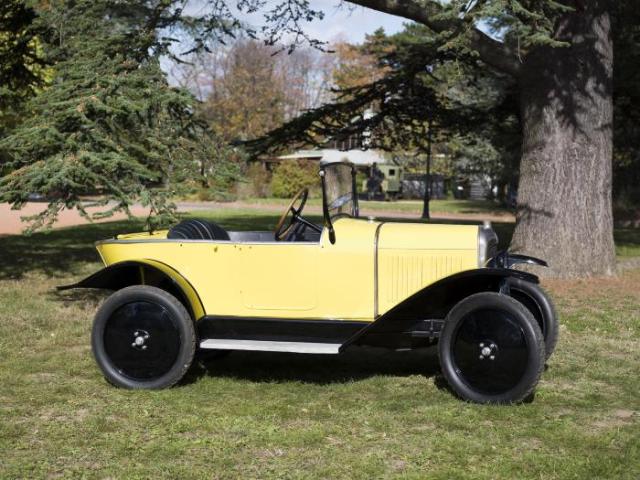
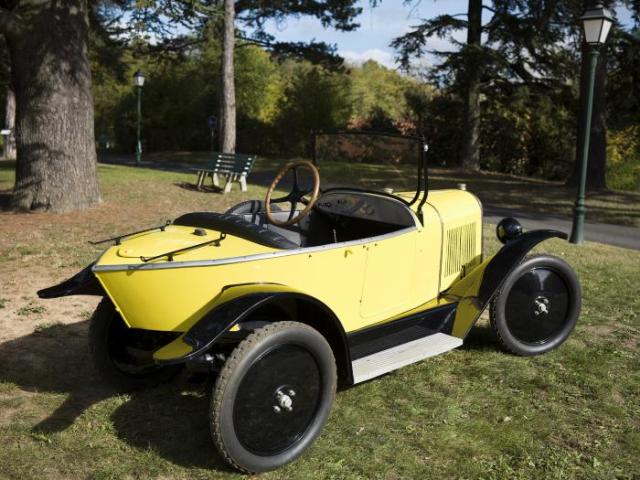
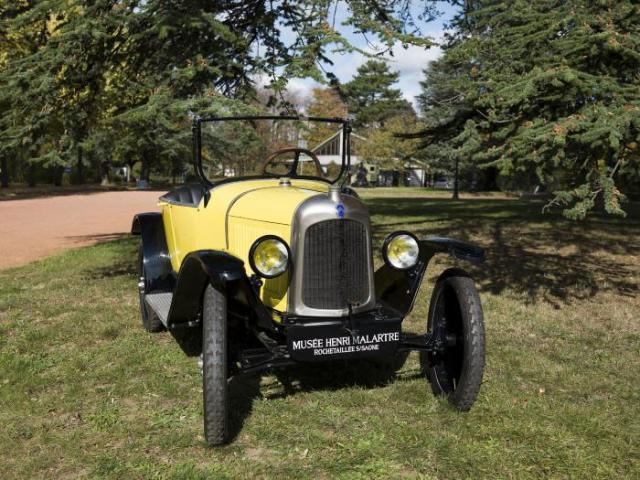
During the First World War, André Citroën adopted the principles of Fordism to mass-produce munitions. After the war, he became the first European automobile manufacturer to embrace large-scale car production. As the automobile gained popularity in Paris during the interwar years, Citroën aimed to make car ownership accessible to as many people as possible. Thanks to assembly-line production, he was able to offer the Citroën 5 HP at a price of 7,250 francs—roughly half the cost of most competing cars at the time. More than 80,000 examples were built between 1923 and 1926 at the Levallois factory.
André Citroën was also one of the first industrialists to use large-scale advertising campaigns to promote his brand. At the opening of the seventh Paris Motor Show in 1922, he had two aircraft use smoke trails to write the name Citroën across the sky. From 1925 to 1934, his name was famously illuminated on the Eiffel Tower. He also commissioned a miniature pedal-powered version of one of his cars for children, hoping that they would grow up wanting to buy a Citroën of their own.
However, these ambitious publicity campaigns, combined with technical difficulties and mounting financial problems, eventually led to the company's downfall. André Citroën was unable to withstand the economic crisis of the 1930s, and the company was taken over by Michelin, whose own business was closely tied to Citroën's success.
- Chassis dimensions: track width 1.18 m; wheelbase 2.83 m
- Storage battery for engine starting, lighting, and electric horn; engine-driven dynamo
- Two-seat torpedo body
- Adjustable windscreen
- Single dry-plate clutch
- Three-speed manual gearbox with reverse, using two sliding gears
- Transmission with a single universal joint
- Worm-and-sector steering