


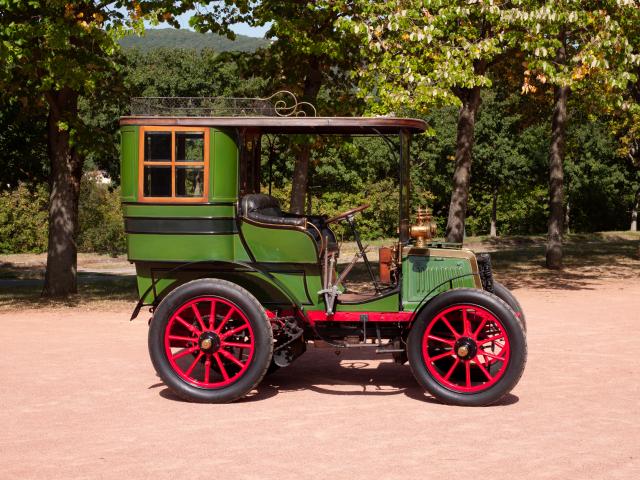
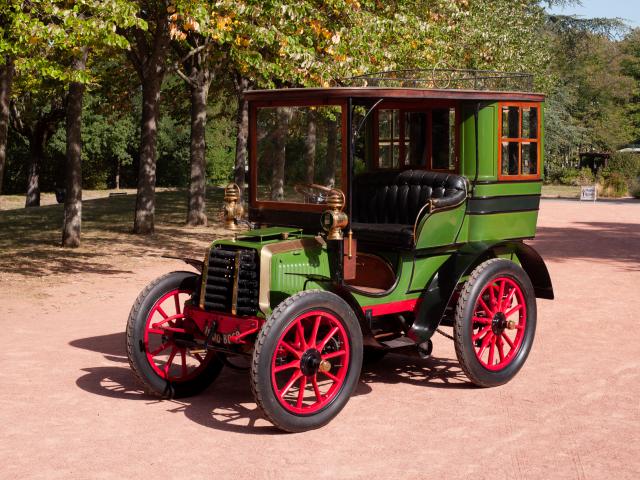
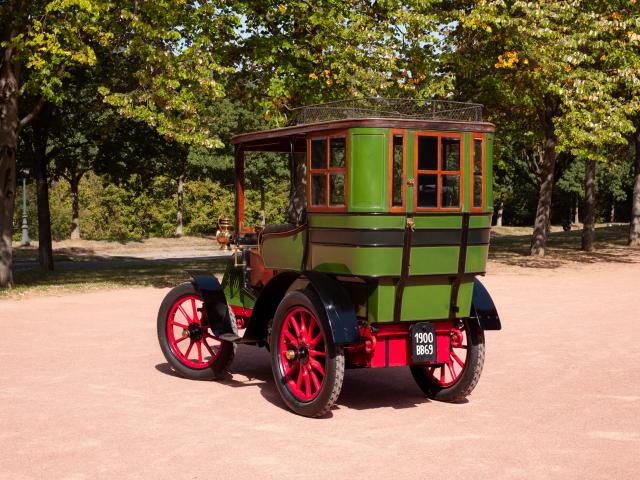
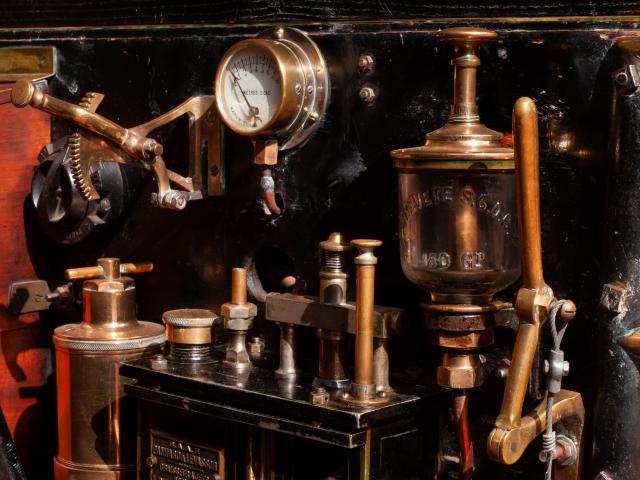
The engineers Panhard and Levassor joined forces in 1886 to found this legendary brand. The first engine used by the company was patented by Daimler. From 1895 onward, it was replaced by a Phénix-Daimler engine developed by the Panhard design office. The company was the first to attempt mass production and broader commercial distribution of automobiles.
-
Engine: Panhard et Levassor Phénix type (Daimler patent), four vertical in-line cylinders in two groups; 81 × 120 mm bore × stroke; displacement: 2,472 cc, 8 hp, 750 rpm.
-
Speed governor acting on the exhaust cams, controlled by the accelerator pedal, which also acts on the carburetor throttle.
-
Ignition by burners and platinum tubes, or by low-tension magneto and spark plugs.
-
Cooling by finned coil radiator and centrifugal water pump.
-
Lubrication by drip-feed oilers and hand “knock” lubricators.
-
Transmission: leather-lined cone clutch. Four-speed inline gearbox with sliding gear and bevel pinion driving either a forward gear ring or a symmetrical reverse gear ring (thus 4 forward speeds and 4 reverse speeds). Differential located at the rear of the gearbox. Final drive by chains to the rear wheels.
-
Chassis: reinforced wooden frame with a metal subframe supporting the powertrain.
-
Suspension: semi-elliptic springs on all four wheels; two rigid axles.
-
Braking: foot brake acting on the transmission (gearbox output), operating in both directions. Handbrake acting only on the rear wheels by external contracting bands, functioning only in forward motion.
-
Maximum speed: approximately 40 km/h